
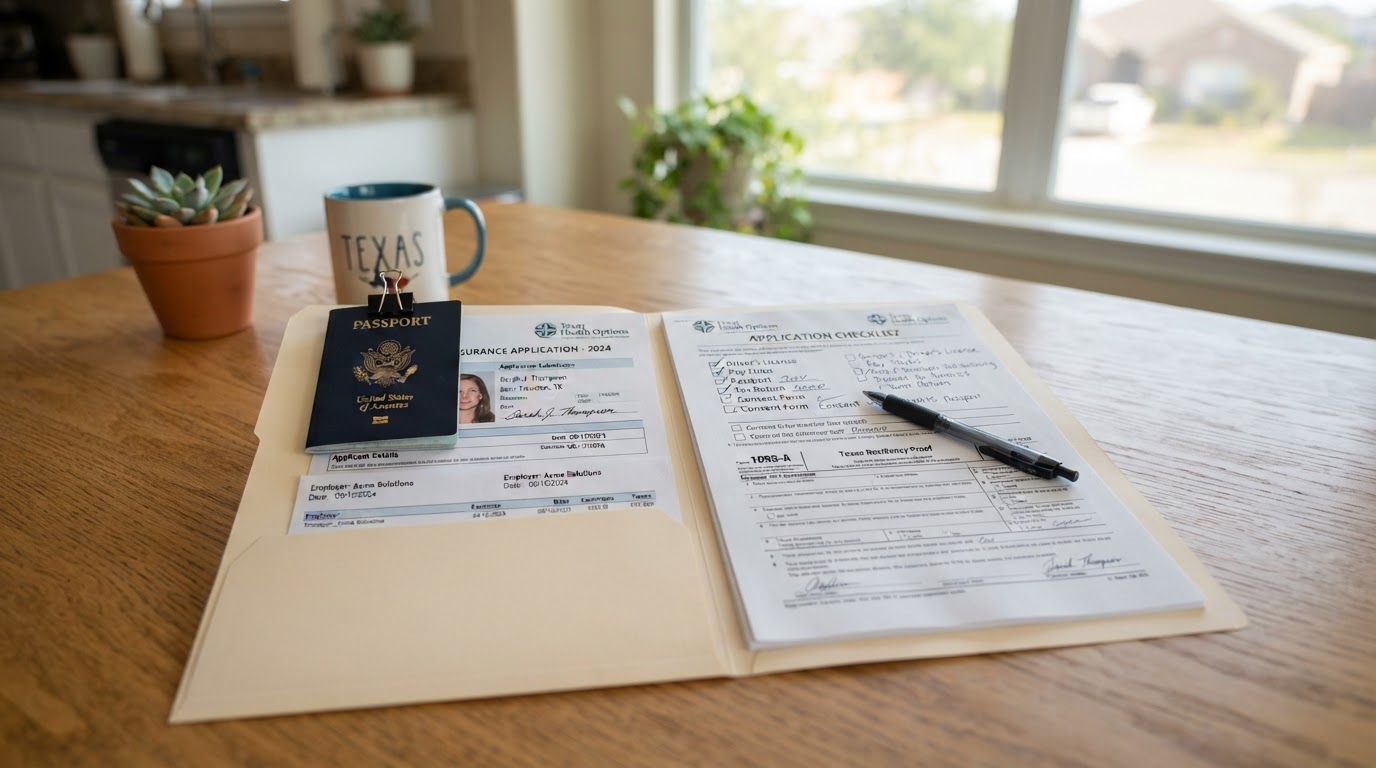






What Documents Do You Need to Apply for ACA Coverage in Texas?
If you're preparing to enroll in a health plan through the federal Marketplace, having the right ACA application documents for Texas ready before you start can save you hours of frustration. Texas uses the federally-facilitated Marketplace at HealthCare.gov — meaning there's no state-run exchange — and the application asks for specific information to verify your identity, income, household size, and current coverage status. Miss a document and you could face coverage delays or lose out on premium tax credits worth thousands of dollars a year.
This guide walks you through every document category you'll need, why each one matters, and insider tips to avoid the most common application mistakes Texas residents make.
Why Your Documents Matter More Than You Think
The ACA Marketplace doesn't just take your word for it. When you apply on HealthCare.gov, the system cross-references your information with IRS tax records, Social Security databases, and Department of Homeland Security files. If your application data doesn't match what those agencies have on file, you'll receive a "data matching issue" notice and have 90 days to submit documentation.
For Texas residents applying for a premium tax credit (also called an Advance Premium Tax Credit, or APTC), accurate income documentation is especially critical. In 2026, subsidies are available to households earning between 100% and 400% of the Federal Poverty Level (FPL) — and in some cases above 400% FPL under enhanced subsidy rules. For a single adult, 100% FPL is approximately $15,060; for a family of four, it's roughly $31,200.
Getting your documents right the first time also speeds up enrollment so your coverage can start as early as the first of the following month. If you're unsure how much financial help you qualify for, use the ACA subsidy calculator for Texas to estimate your savings before you apply.
ACA Application Documents Texas Checklist: Identity & Residency
The Marketplace needs to confirm who you are and that you live in the United States legally. Here's what to have on hand:
Proof of Identity
- Social Security Number (SSN) — Required for every household member applying for coverage. If you don't have an SSN, a Social Security card or official SSA letter will be requested.
- Date of birth for each applicant
- U.S. citizenship or immigration status documents — For naturalized citizens, a Certificate of Naturalization (Form N-550 or N-570). For lawful permanent residents, a Green Card (Form I-551).
Proof of Texas Residency
The Marketplace requires proof that you currently live in Texas. Acceptable documents include:
- A recent utility bill with your name and Texas address
- A lease or mortgage statement
- A Texas driver's license or state-issued ID
- A postmarked piece of official mail (bank statement, government letter)
Moving to Texas from another state? The new Texas resident health insurance guide covers how to handle your coverage transition and what qualifies as a Special Enrollment Period trigger.
Income Documents: The Most Important Category
Income documentation is where most Texas applicants run into trouble. The Marketplace uses your projected annual income for the coverage year — not last year's income — to calculate your subsidy. However, past tax returns help establish a baseline, and the system will check your information against IRS data.
For Employees (W-2 Workers)
- Most recent federal tax return (Form 1040) — ideally the prior year's return
- Recent pay stubs (last 2–3 months)
- W-2 forms from the prior tax year
- Employer name and contact information
For Self-Employed or Freelancers
- Most recent federal tax return including Schedule C or Schedule SE
- Business records showing recent income and expenses
- 1099 forms from clients or platforms
- A written estimate of projected annual net income if your income has changed significantly
For Other Income Sources
- Social Security: SSA award letter or Form SSA-1099
- Unemployment benefits: Award letter from the Texas Department of Economic Opportunity
- Retirement or pension: 1099-R or pension award letter
- Rental income: Schedule E from your most recent tax return
- Alimony (pre-2019 divorces): Divorce decree and records of amounts received
- Child support: Court order or payment records (note: child support is generally not counted as income for ACA purposes)
Pro tip: If your income this year will be significantly higher or lower than last year, document the reason (job change, new freelance work, retirement) so a licensed agent can help you report it correctly and avoid a tax bill at filing time.
Household & Dependency Documents
Your household size directly affects both your subsidy amount and whether household members qualify for Texas Medicaid instead of a Marketplace plan. Texas's Medicaid eligibility for adults is limited — the state has not expanded Medicaid under the ACA, so adults without dependent children generally must earn at or above 100% FPL to qualify for Marketplace subsidies rather than Medicaid.
Documents you may need:
- Marriage certificate — if enrolling a spouse
- Birth certificates — for dependent children
- Adoption decree or foster care documentation — for non-biological dependents
- Divorce decree — if claiming a dependent whose custody is shared
- Tax records showing dependents — the Marketplace may ask you to confirm who you claimed on last year's return
If you're covering children or a full family, the family health insurance Texas guide has additional details on dependent eligibility rules and CHIP coverage for children.
Current Coverage Documents
The Marketplace application asks about any existing health coverage — employer-sponsored plans, Medicare, Medicaid, TRICARE, or coverage through a parent's plan. This is important because having access to "affordable" employer coverage that meets minimum value standards can make you ineligible for premium tax credits, even if you choose not to take it.
Have the following ready if applicable:
| Coverage Type | Document Needed |
|---|---|
| Employer-sponsored plan | Summary Plan Description or HR benefits letter showing employee premium cost |
| Medicare | Medicare card or award letter |
| Medicaid/CHIP | Medicaid ID or award letter |
| COBRA | COBRA election notice |
| Veterans/TRICARE | Military ID or TRICARE enrollment card |
| Prior Marketplace plan | 1095-A form from previous year |
Your Form 1095-A from the prior year is especially important if you received advance premium tax credits. You'll need it to complete Form 8962 on your taxes and reconcile your subsidy.
If you're switching from another plan — including off-Marketplace coverage — review the process for switching health insurance plans in Texas to make sure you don't have a gap in coverage.
Special Situations: Documents for SEPs and Hardship Exemptions
If you're applying outside of Open Enrollment through a Special Enrollment Period (SEP), you'll need documentation of your qualifying life event. The Marketplace is strict about this — you typically have 60 days from the event date to enroll.
Common SEP Documents
- Loss of job-based coverage: Letter from employer or insurer confirming the end date of prior coverage
- Marriage: Marriage certificate
- Birth or adoption: Birth certificate or adoption decree
- Move to Texas: Proof of prior address (utility bill, lease) plus proof of new Texas address
- Release from incarceration: Release papers
For a full breakdown of qualifying events, the Special Enrollment Period Texas guide covers every scenario in detail, including recent federal rule changes.
Quick-Reference: Documents Organized by Applicant Type
First-time applicants enrolling during Open Enrollment:
- Government-issued photo ID or SSN
- Proof of Texas address
- Most recent federal tax return (Form 1040)
- Recent pay stubs or income documentation
- Current employer benefits letter (if offered employer coverage)
- Birth certificates for any dependents
Re-enrolling applicants:
- Prior year Form 1095-A
- Updated income documentation if your earnings changed
- Any new dependency or household changes
- Updated immigration documents if applicable
Self-employed applicants:
- Schedule C from most recent tax return
- 1099 forms
- Year-to-date profit/loss summary
- SSN and proof of address
How to Submit Documents to HealthCare.gov
Once you've completed your application on HealthCare.gov, you can upload supporting documents directly through your account. Here's how:
- Log in to your HealthCare.gov account and go to your application.
- Look for any open "data matching issues" or document requests in your To-Do list.
- Click "Upload documents" and select the appropriate document type.
- Upload clear photos or scans (PDF, JPG, or PNG — under 10MB each).
- Allow up to 2 weeks for processing; check your account for confirmation.
You can also mail documents to the address on your notice, or call the Marketplace at 1-800-318-2596. However, uploading online is the fastest method.
Texas note: Because Texas uses the federally-facilitated Marketplace (not a state exchange like Covered California), all document submission goes through HealthCare.gov — not a Texas state agency.
Choosing the Right Plan Once You're Approved
Once your application is verified and your subsidy is confirmed, you'll need to choose a plan. Texas offers Bronze, Silver, Gold, and Platinum tier options from multiple insurers. The Silver tier is typically the best value for subsidy-eligible enrollees because it's the only tier where Cost-Sharing Reductions (CSRs) apply — lowering your deductibles and out-of-pocket costs if your income is between 100–250% FPL.
For help comparing your options, see our guide to ACA metal tiers in Texas or compare health insurance plans in Texas side by side.
Related Reading
- Special Enrollment Period Texas: Your Complete Guide
- ACA Subsidy Calculator Texas: Estimate Your Savings
- Family Health Insurance Texas: Cover Your Kids
Get Help With Your ACA Application in Texas
Gathering ACA application documents for Texas doesn't have to be stressful. A licensed agent can review your documents, help you accurately report your income, and ensure you're getting every dollar of subsidy you're entitled to — at no cost to you.
Visit CoveredTX.com for free quotes, or call (833) 633-6777 to speak with a licensed Texas health insurance agent today.
Top-Rated Carriers
- A+ rating
- BBB accredited business
- Customer recommended
Frequently Asked Questions
What documents do I need to apply for ACA health insurance in Texas?
You'll need a government-issued ID or Social Security Number, proof of Texas residency, recent income documentation (pay stubs, tax return, or 1099s), and information about any current health coverage. Self-employed applicants should also have Schedule C from their most recent federal tax return. Having these ready before you start your HealthCare.gov application speeds up the process significantly.
Do I need my tax return to apply for a Marketplace plan in Texas?
Your most recent federal tax return (Form 1040) is strongly recommended but not always required to start the application. The Marketplace cross-checks your stated income against IRS records. If there's a mismatch, you'll receive a data matching notice and need to upload documentation — which is why having last year's return handy from the start prevents delays.
What income counts when applying for ACA subsidies in Texas?
Modified Adjusted Gross Income (MAGI) is used for ACA subsidy calculations. This includes wages, self-employment income, Social Security benefits, alimony received (pre-2019 divorces), rental income, and investment income. Child support received is generally excluded. Texas has not expanded Medicaid, so adults without dependents typically need income at or above 100% FPL (~$15,060 for one person in 2026) to qualify for Marketplace subsidies.
What is a 1095-A form and why do I need it?
Form 1095-A is the Health Insurance Marketplace Statement sent to anyone who had a Marketplace plan in the prior year. It shows the premiums paid, the benchmark Silver plan premium, and any advance premium tax credits received. You need it to complete IRS Form 8962 at tax time to reconcile your subsidy. If you're re-enrolling, having last year's 1095-A also helps confirm your prior coverage dates.
How do I submit documents to HealthCare.gov if there's a data matching issue?
Log in to your HealthCare.gov account, navigate to your application, and look for open document requests in your To-Do list. You can upload PDFs, JPGs, or PNGs directly through the portal. Documents are typically reviewed within two weeks. You can also mail documents to the address listed on your notice, but online upload is faster. A licensed agent at CoveredTX.com can help you identify which documents to submit.
Ready to find your plan?
Get free quotes from licensed Texas agents in minutes.